Type guide · D7
Challenger Executor
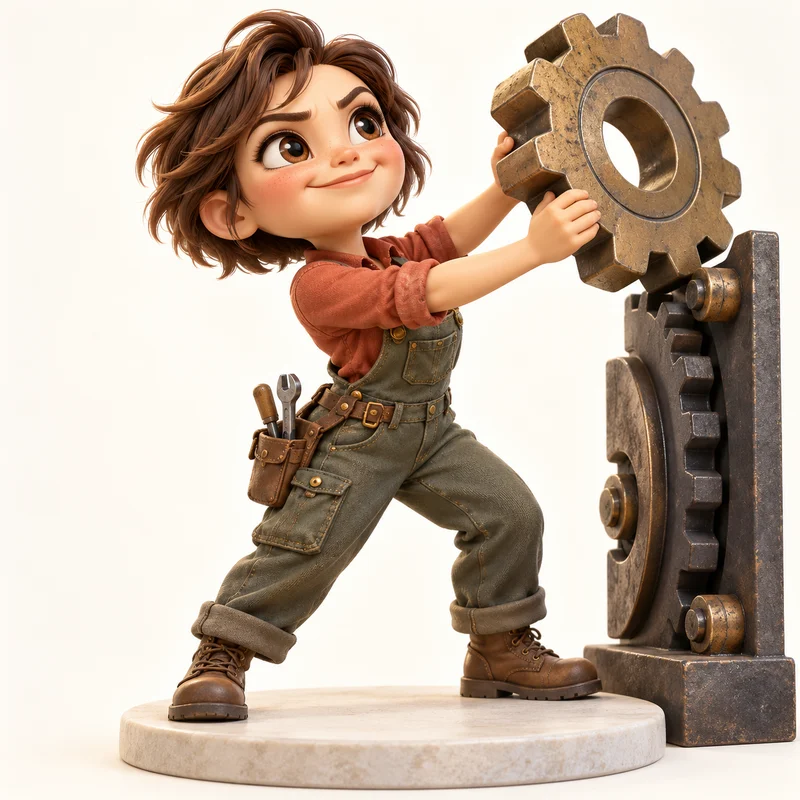
Starts small and adjusts through practical experience. · Finds interest in a demanding next step.
The first-step maker
Lifts a large sculptural gear into place with determined grin.
Characters are visual metaphors for response patterns, not judgments about appearance, gender or occupation.
Example role to explore
Robotics engineer
An example role to explore building something and improving the process. Try choosing a challenging task.
A small activity to try
Build a tiny prototype or feature and note one improvement.
Did you enjoy the activity itself? Consider whether you want to learn the required skills and explore the real work.
An editorial exploration example, not a job-fit or ability score.
This is a type introduction. Complete the test to see your own scores and learning profile.
Patterns you may recognize
Doing something may give you information that thinking alone does not. A first attempt reveals obstacles, and repeated practice can help you refine your approach. Checking one condition before starting and one lesson afterward helps experience become a useful guide for the next attempt. You may become interested when a task is a little beyond the familiar. This can draw your usual approach toward ambitious goals. Adjusting difficulty and recording small discoveries helps challenge remain useful without making one outcome a judgment of yourself. Use this description as a starting point for reflection. People with the same type can behave differently across experiences and settings. Notice what fits and what does not, then try one suggestion in your everyday life.
Strengths you may draw on
- Beginning a first attempt
- Learning from practical feedback
- Trying a higher level of difficulty
- Focusing on an explicit goal
Situations worth noticing
- Action may come before reading every condition.
- Check what repeated practice is improving.
- Hard tasks can crowd out foundational practice.
- One attempt does not define your abilities.
Study habits to try today
- Mark the conditions before you begin.
- Write down one change for your next attempt.
- Check the basics before one harder task.
- Record a discovery as well as the outcome.